
Political Science and International Relations
Political Science and International Relations (PSIR) is a most preferred choice for UPSC aspirants due to its scoring potential and strong overlap with the General Studies (GS) syllabus.
Prelims Friendly
Indian Polity: 15-20 Questions
World Politics and International Organisations: 5-8 Questions
Strong GS Overlap
GS Paper II: Direct overlap with polity and governance.
GS I, III, IV: Useful insights for socio-economic and ethical issues.
Current Affairs Relevance
Paper II, especially International Relations, aligns with ongoing global and national issues.
Scoring Potential
PSIR has consistently been recognized for its scoring potential in the UPSC CSE.
Holistic Preparation
The wide coverage of PSIR complements the General Studies syllabus across Mains papers.
Interview Support
A strong PSIR foundation helps aspirants articulate informed opinions during the interview.
With its depth and versatility, PSIR is a strategic choice for UPSC CSE aspirants aiming to optimize their preparation and score well in Mains.
| Factor | PSIR | Sociology | Geography | History |
|---|---|---|---|---|
| GS Overlap | Very High | Medium | High (GS1) | High (GS1) |
| Syllabus Size | Medium | Medium | Large | Very Large |
| Scoring Potential | High (300+) | Medium-High | Medium | Medium |
| Current Affairs Need | Very High | High | Medium | Low |
| Answer Style | Analytical | Conceptual | Factual + Maps | Narrative |
Paper I - Political Theory and Indian Politics
Section A: Political Theory and Indian Politics
- Political theory: meaning and approaches.
- Theories of the state: Liberal, Neo-liberal, Marxist, Pluralist, Post-colonial and feminist.
- Justice: Conceptions of justice with special reference to Rawl’s theory of justice and its communitarian critiques.
- Equality: Social, political and economic; the relationship between equality and freedom; Affirmative action.
- Rights: Meaning and theories; different kinds of rights; the concept of Human Rights.
- Democracy: Classical and contemporary theories; different models of democracy-representative, participatory and deliberative.
- Concept of power: hegemony, ideology and legitimacy.
- Political Ideologies: Liberalism, Socialism, Marxism, Fascism, Gandhism and Feminism.
- Indian Political Thought: Dharmashastra, Arthashastra and Buddhist traditions; Sir Syed Ahmed Khan, Sri Aurobindo, M.K. Gandhi, B.R. Ambedkar, M.N. Roy.
- Western Political Thought: Plato, Aristotle, Machiavelli, Hobbes, Locke, John S. Mill, Marx, Gramsci, Hannah Arendt
Section B: Indian Government and Politics
- Indian Nationalism:
- Political Strategies of India’s Freedom struggle: constitutionalism to mass Satyagraha, Non-cooperation, Civil Disobedience; militant and revolutionary movements, Peasant and workers’ movements.
- Perspectives on Indian National Movement: Liberal, Socialist and Marxist; Radical humanist and Dalit.
- Making of the Indian Constitution: Legacies of the British rule; different social and political perspectives.
- Salient Features of the Indian Constitution: The Preamble, Fundamental Rights and Duties, Directive Principles; Parliamentary System and Amendment Procedures; Judicial Review and Basic Structure doctrine.
- a. Principal Organs of the Union Government: Envisaged role and actual working of the Executive, Legislature and Supreme Court.
- b. Principal Organs of the State Government: Envisaged role and actual working of the Executive, Legislature and High Courts.
- Grassroots Democracy: Panchayati Raj and Municipal Government; the significance of 73rd and 74th Amendments; Grassroot movements.
- Statutory Institutions/Commissions: Election Commission, Comptroller and Auditor General, Finance Commission, Union Public Service Commission, National Commission for Scheduled Castes, National Commission for scheduled Tribes, National Commission for Women; National Human Rights Commission, National Commission for Minorities, National Backward Classes Commission.
- Federalism: Constitutional provisions; changing nature of centre-state relations; integrationist tendencies and regional aspirations; inter-state disputes.
- Planning and Economic Development: Nehruvian and Gandhian perspectives; the role of planning and public sector; Green Revolution, land reforms and agrarian relations; liberalization and economic reforms.
- Caste, Religion and Ethnicity in Indian Politics.
- Party System: National and regional political parties, ideological and social bases of parties; patterns of coalition politics; Pressure groups, trends in electoral behaviour; changing socio-economic profile of Legislators.
- Social Movements: Civil liberties and human rights movements; women’s movements; environmentalist movements
Paper II - World Politics & India and World
Section A: Comparative Political Analysis and International Politics
- Comparative Politics: Nature and major approaches; political economy and political sociology perspectives; limitations of the comparative method.
- State in comparative perspective: Characteristics and changing nature of the State in capitalist and socialist economies, and, advanced industrial and developing societies.
- Politics of Representation and Participation: Political parties, pressure groups and social movements in advanced industrial and developing societies.
- Globalisation: Responses from developed and developing societies.
- Approaches to the Study of International Relations: Idealist, Realist, Marxist, Functionalist and Systems theory.
- Key concepts in International Relations: National interest, Security and power; Balance of power and deterrence; Transnational actors and collective security; World capitalist economy and globalisation.
- Changing International Political Order:
- (a) Rise of superpowers; strategic and ideological Bipolarity, arms race and Cold War; nuclear threat;
- (b) Non-aligned movement: Aims and achievements;
- (c) Collapse of the Soviet Union; Unipolarity and American hegemony; relevance of non-alignment in the contemporary world.
- Evolution of the International Economic System: From Bretton woods to WTO; Socialist economies and the CMEA (Council for Mutual Economic Assistance); Third World demand for new international economic order; Globalisation of the world economy.
- United Nations: Envisaged role and actual record; specialized UN agencies-aims and functioning; the need for UN reforms.
- Regionalisation of World Politics: EU, ASEAN, APEC, SAARC, NAFTA.
- Contemporary Global Concerns: Democracy, human rights, environment, gender justice, terrorism, nuclear proliferation.
Section B: India and the World
- Indian Foreign Policy: Determinants of foreign policy; institutions of policy-making; continuity and change.
- India’s Contribution to the Non-Alignment Movement: Different phases; current role.
- India and South Asia:
- Regional Co-operation: SAARC-past performance and future prospects.
- South Asia as a Free Trade Area.
- India’s “Look East” policy.
- Impediments to regional co-operation: river water disputes; illegal cross-border migration; ethnic conflicts and insurgencies; border disputes.
- India and the Global South: Relations with Africa and Latin America; leadership role in the demand for NIEO and WTO negotiations.
- India and the Global Centres of Power: USA, EU, Japan, China and Russia.
- India and the UN System: Role in UN Peace-keeping; demand for Permanent Seat in the Security Council.
- India and the Nuclear Question: Changing perceptions and policy.
- Recent developments in Indian Foreign policy: India’s position on the recent crisis in Afghanistan, Iraq and West Asia, growing relations with US and Israel; the vision of new world order.
PS IS YOUR GS
Benefits of Joining PSIR Subject Classes with Raja Sir
PSIR Optional Classes - Features
Syllabus Coverage
Comprehensive and timely completion of the syllabus. 400+ hours of classroom teaching including tests and discussions.
Answer Writing Practice
Integrated answer writing sessions with dedicated test series and personalized feedback.
Class Format
Sessions available both offline and online with regular class tests to track progress.
Study Materials
Six volumes of our institute books available.
Approaching PSIR Optional Subject
To prepare Political Science & International Relations (PSIR) for UPSC Mains, focus on building strong conceptual foundations in political theory and Indian politics, while integrating current affairs into international relations. The key is structured study, answer writing practice, and leveraging the overlap with GS papers and Essay.
- Understand the Syllabus
- Paper I: Political Theory & Indian Politics
- Western thinkers (Plato, Aristotle, Hobbes, Locke, Marx, Rawls)
- Indian thinkers (Kautilya, Gandhi, Ambedkar, M.N.Roy)
- Indian Constitution, federalism, party system, judiciary
- Social movements, pressure groups, communalism, regionalism
- Paper II: International Relations
- IR theories (Realism, Liberalism, Marxism, Constructivism)
- Cold War, post-Cold War, multipolarity
- India’s foreign policy (NAM, neighbourhood, Act East, Look West)
- Global institutions (UN, WTO, IMF, World Bank)
- Build Conceptual Foundations
-
- Start with standard books:
- Political Theory by O.P. Gauba
- Our Institute Books
- Supplement with IGNOU notes for clarity on political thought.
- Start with standard books:
- Integrate Current Affairs
-
- Read The Hindu, Indian Express, and ORF articles daily.
- Link contemporary issues (e.g., India-China relations, UN reforms, G20 diplomacy) with IR theories.
- Maintain a notes file mapping current events to syllabus topics.
- Answer Writing Practice - https://iasgoogle.com/Mains/daily_practice/psir-daily-practice
-
- Practice PYQs (Previous Year Questions) regularly.
- Structure answers with:
- Intro: Define concept/theory
- Body: Analytical discussion with examples
- Conclusion: Balanced, forward-looking perspective
- Use thinkers’ quotes (e.g., Gandhi, Ambedkar, Rawls) to enrich answers.
- Leverage GS Overlap
-
- GS Paper II: Polity, governance, federalism, judiciary → overlaps with Paper I.
- GS Paper III: International relations, foreign policy → overlaps with Paper II.
- Essay Paper: Political philosophy, democracy, governance themes.
Action Plan for You:
- Cover Paper I in 2 months (theory + Indian politics).
- Cover Paper II in 2 months (IR + foreign policy).
- Dedicate 1 month for revision + PYQ practice.
- Daily newspaper + monthly magazine (IASgoogle.com, Yojana, EPW) for current affairs.
- Weekly answer writing practice with feedback.
Ideally
This course is ideal for aspirants who:
- Aim for a high-scoring optional subject with significant overlap in General Studies.
- Have an interest in political theory, governance, and international relations.
- Seek a structured approach with expert guidance and consistent feedback
CLASSES
STUDY MATERIALS
TEST SERIES
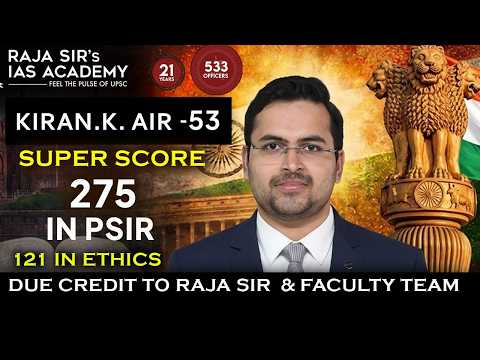
Student Testimonials
Anshul Gupta IAS
Verified StudentHe Studied Electrical Engineering at IIT, Kharagpur. Despite his brilliant academics and lucrative Career in Private Sector, with his prestigious IIM (Bangalore) graduation, he aspired to become IAS and cracked the toughest nut of UPSC with his patience and perseverance. He made investment on himself, worked for it, and is now a Unicorn in himself.

Siva Krishnamoorty IAS
Verified StudentHis impressive writing abilities with clarity of thought made him achieve this. He used to write tests and essays and come to institute after 7.00 pm also. On Few Days he had even come at 9.00 p.m. That shows his dedication. Our faculty had waited till he comes. That’s the kind of personal touch every student gets at our Institute.
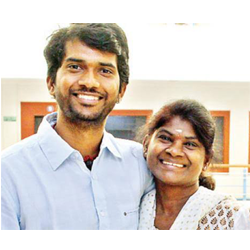
Bharani Kumar IAS
Verified StudentRaja Sir’s guidance and support helped me achieving my dream service of IAS. My optional subject was Political Science and International Relations. I fully relied on Sir’s inputs. Its my pleasure to thank him for his mentoring.
Jai Arvind IRS
Verified StudentAn alumni of College of Engineering, Guindy, Anna University, IIM Graduate, Ex Employee of RBS, is now an Indian Revenue Service Officer. He enrolled with us for Classes of Sociology, Political Science and International Relations, Current Affairs and General Studies Prelims Test Batch. He also guided our students for one batch of CSAT – Aptitude.
Rajarshi Das Gupta IRS
Verified StudentI joined Raja Sir’s Cracking IAS for General Studies & Essay. Study materials and tests provided by Raja Sir were crispy and catering to the exact demands of UPSC Civil Services Exam. Thank you Raja Sir.
Nitika Pawar IAS (AIR, 18)
Verified StudentNitika Pawar obtained 18th rank in Civil Services Examination 2011 in her first attempt for the most prestigious position of Indian Administrative Services (IAS). Nitika Pawar had completed her B.Tech in Biotechnology. She joined us for the optional subject Political Science and International Relations.
Saranya Baskar IAAS, AIR 143
Verified StudentShe is an alumnus of MOP Vaishnav College for Women, Chennai . With her tireless efforts and calm, composed approach to UPSC Civil Services Exam, she made it in her very first attempt immediately after her Graduation. Her optional subject was Political Science and International Relations.
U. Swaroop IAS
Verified StudentSir, I got personalised attention and especially your tests have helped me a lot. I will not forget your emphasis on Phytoremediation question which exactly got reflected in GS – Mains. Points notified during Mock Interview Session helped me to perform well in UPSC Interview.
Uma Maheshwari ICLS
Verified StudentShe was deeply impacted by something that Steve Jobs often spoke about – connecting the dots. “You have to place your trust and belief in something and keep working towards it. It will all somehow start making sense and come together,” says Uma. After facing so many failures, Uma just got it in her 6th attempt.